
Commercial trucking companies are required by law to keep copies of all log books for at least six months. The information in these records can play a key role in proving negligence.
For instance, if a driver violated hours of service regulations in order to meet a deadline and then fell asleep at the wheel, the log books recording when the driver last took a break could help convince a judge or a jury of the driver’s negligence.
LAW REQUIREMENT

TRUCK ACCIDENT STATISTICS
The Federal Motor Carrier Safety Administration (FMCSA) estimates that around 60 percent of all fatal crashes involving large trucks occur on rural roads, with a further 25 percent taking place on highways. The FMCSA also reports that hazardous cargo was present during three percent of large truck collisions. In most cases, the hazardous materials included flammable liquids, such as gasoline and fuel oil. This kind of cargo accounted for 67 percent of the hazardous material releases in truck accidents.
Although a variety of heavy trucks are involved in collisions, the most common include single cabs pulling semi-trailers. Finally, the National Highway Traffic Safety Administration (NHTSA) reports that fatal truck crashes are on the rise and in a single recent year, as many as 4,067 people lost their lives in collisions with heavy trucks. Of those who tragically lost their lives, around 73 percent were occupants of passenger vehicles.

CALL TODAY TO SPEAK WITH AN EXPERIENCED TUKWILA TRUCK ACCIDENT ATTORNEY
If you were injured in a truck accident, please contact the Khan Law Firm at 206-629-9312 to schedule a free consultation with a skilled truck accident attorney who can evaluate your case. You can also reach us by sending a brief online message or by initiating a live chat with a member of our legal team.

TUKWILA TRUCK ACCIDENT ATTORNEY
THERE FOR YOU THROUGH THE UNEXPECTED

According to the Washington State Department of Transportation, as many as 3,161 collisions involving heavy trucks occur in the state on a yearly basis. Around 2,398 of those crashes resulted in severe property damage, while 689 involved injuries. In fact, as many as 933 people sustain injuries in serious truck crashes in the state every year. Accidents involving large trucks are not restricted to Washington, as it is estimated that around 415,000 truck accidents occur every year across the country, 83,000 of which lead to injury.
Truck accidents tend to result in especially devastating injuries, many of which leave victims permanently disabled. Fortunately, when an injured party can demonstrate that someone else’s negligence caused the crash, he or she may be able to collect damages, so if you were injured in a truck crash in Washington, it is critical to speak with an experienced Tukwila truck accident attorney who can help you seek compensation for your losses.


Whether the truck involved in a crash was a semi-trailer, flatbed, or tanker, most collisions involving large commercial vehicles are caused by:
-
Falling asleep at the wheel;
-
Driving while under the influence of drugs or alcohol;
-
Speeding or driving aggressively;
-
Driving while distracted;
-
Tire blow-outs;
-
Mechanical failure; and
-
Cargo spills.
To help prevent these kinds of negligent and reckless acts, the federal government instituted a series of regulations with which the trucking industry must comply. These rules regulate the following areas:
-
How long a driver is permitted to operate a truck without taking a break;
-
The proper method of loading and unloading cargo;
-
Vehicle weight limits;
-
How and when to conduct safety inspections;
-
Driver qualifications; and
-
How to perform proper maintenance.
Truck drivers are also legally prohibited from driving a commercial vehicle if they have a blood alcohol concentration (BAC) of 0.04 or more. This threshold is much lower than the nationwide legal limit of 0.08 percent.
Unfortunately, drivers and truck companies do not always adhere to these rules, which can lead to the following types of truck accidents:
-
Jackknife accidents;
-
Multi-vehicle crashes;
-
Rear end accidents;
-
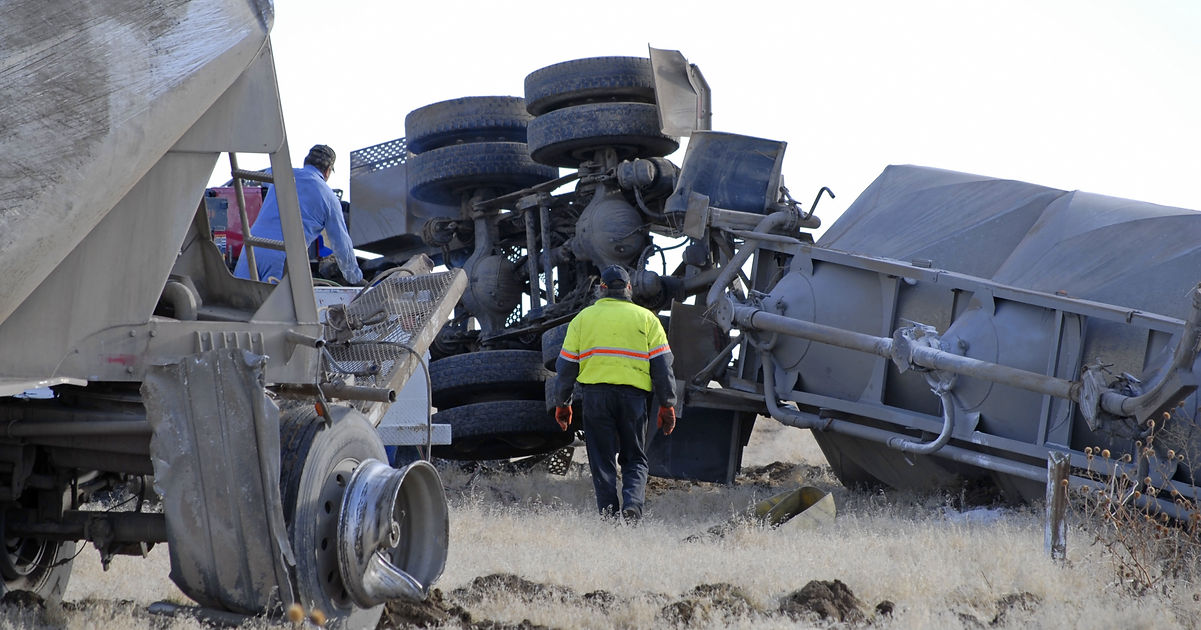
Rollovers; and
-
Underride accidents, in which the smaller vehicle becomes lodged underneath a large truck.
Any one of these kinds of accidents could result in severe, and even deadly, injuries.
Liable Parties
When truck drivers and truck companies do not comply with federal and state regulations, they can be held liable for resulting injuries. Possible liable parties include:
-
Truck drivers who were negligent or reckless;
-
The driver’s employer if it failed to provide adequate training, engaged in negligent hiring practices, failed to supervise its employees, or did not require the completion of safety inspections;
-
Vehicle parts manufacturers if they negligently designed or assembled a car part;
-
Mechanics who failed to perform proper maintenance or repair a broken part; and
-
Other drivers on the road whose negligence caused the crash.
When an injured party can demonstrate that one or more of these individuals or entities were responsible for a crash, they may be able to collect damages, including compensation for:
-
Past and future medical expenses;
-
Lost wages;
-
Property damage;
-
Loss of future income; and
-
Pain and suffering.
Collecting these types of damages is especially important for truck accident victims, as the injuries sustained in these types of crashes tend to be especially severe and include everything from lacerations and head trauma to broken bones and spinal cord damage. However, before a plaintiff can collect damages, he or she must be able to demonstrate that another party violated a federal regulation or was otherwise negligent. This usually requires the collection of specific evidence, including:
-
The police report detailing the crash;
-
The results of the driver’s commercial motor vehicle examination;
-
The driver’s log books;
-
Data recorded on in-vehicle technologies; and
-
The parties’ medical records.
The driver’s log books are often especially helpful in demonstrating fault as they must contain certain information, including:
-
The number of miles driven per day;
-
The truck’s vehicle number;
-
Any shipping or cargo document numbers;
-
A grid that tracks the driver’s travel in one-hour increments;
-
Notations that carefully describe when a driver was on duty, on duty but not driving, or off duty; and
-
Notes indicating when and where rest breaks were taken.